
Breaking the myth: Green sand delivers speed, quality and cost advantage
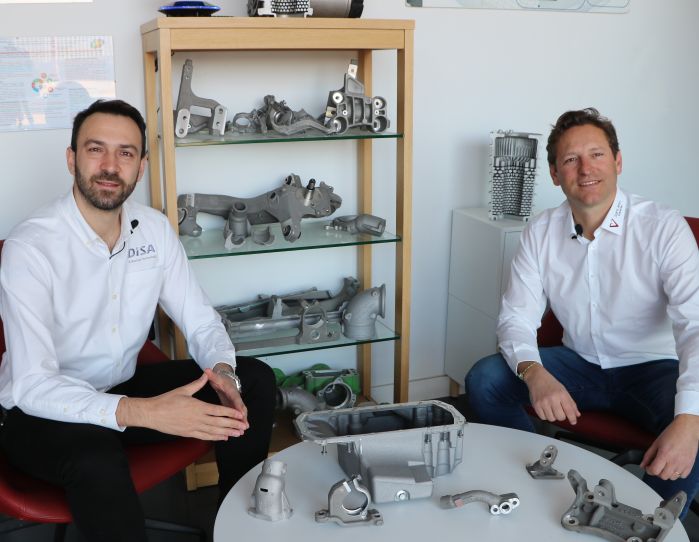
Today we had a conversation with Edouard Tavernier from Saint Jean Industries who has been working at Saint Jean Industries for more than 20 years in the sales department, being responsible for business development across Europe, and Eren Koc, who is working as a Team Leader for OEM sales at DISA. Eren has been with DISA around five years.
In the conversation, Edouard and Eren address the common perceptions and concerns foundries face when comparing traditional die casting methods against sand moulding.
Could you walk us through how this partnership between Saint Jean Industries and DISA began? What was the initial spark that brought SJI and DISA together?
Eren: The story is that Saint Jean and DISA have been partners for many years. We are now combining our strengths to lead the shift towards high-efficiency manufacturing.
We share a strong commitment to collaborate and communicate clearly about “high-efficiency manufacturing” in order to gain the trust of the market.
By “high-efficiency manufacturing”, we refer to maximum output, lower costs, higher flexibility, and quick tooling changes. This also includes high speed - up to 300 shots per hour. This level of output can be achieved with only 3–4 operators.
In comparison, achieving the same output with the die casting method requires 3–4 times more personnel and additional equipment.
Edouard: And by integrating Saint Jean Industries expertise with DISA’s green sand technology, we are making both low and high-volume aluminium production more affordable, sustainable and more efficient than ever before, compared to standard technologies.
Choosing the DISA green sand technology instead of die casting can generate cost reduction up to 15% on part price and reduce the tooling costs. In DISA Moulding we do not use die coating which is chemical and harmful to the environment. We do not use water to cool dies, which means less water consumption, and the same output can be reached with fewer machines.
The integration of DISA technology with bottom-filling sand casting is a significant milestone. What was the strategic vision behind this breakthrough, and what specific problem were you looking to solve?
Eren: Well, for us the strategic vision was simple.
We want aluminium casting buyers to benefit from the same high efficiency and high-speed production that iron casting buyers have benefited from for 60 plus years.
Edouard: Yeah, and by integrating the DISAMATIC moulding line with bottom-filling sand casting, we have solved the problem of turbulence-related defects that typically reduce the mechanical properties of aluminium.
Bottom filling provides a laminar flow when filling the mould. This helps reduce turbulence and, consequently, the formation of oxide. As a result, we can produce better castings and achieve higher mechanical properties. Aluminium forms oxides when it comes into contact with oxygen. These oxides are unwanted in aluminium castings, as they act as impurities and reduce mechanical properties.
The use of EPGS represents an evolution compared to existing technologies.
EPGS refers to bottom pouring, which enables foundries to produce high-quality parts at a scale that has traditionally only been possible in steel casting production.
Higher elongation and higher yield strength result in better quality and improved mechanical properties.
In the current global landscape, where does green sand aluminum production fit in? How does it differentiate itself from other casting methods in today's competitive market?
Edouard: Green sand is not a “one-size-fits-all” solution, but it offers broad applicability. By this, I mean that, using DISA green sand technology, aluminium castings can be produced for a wide range of industries, including automotive, agriculture, industrial, and electrical.
This methodology differentiates itself by delivering the same “rapid-fire efficiency” that the iron industry has relied on for decades.
Please explain – what is “rapid-fire efficiency?
Edouard: In this context, “rapid-fire” is the opposite of a one-by-one process. It is enabled by DISA technology and the automation of pouring.
“Rapid-fire” means high speed - up to 300 shots per hour. In comparison, die casting typically achieves a maximum of 60–70 shots per hour (it is based on expensive automated casting carousels), a single machine will not be providing more than 20 shots per hour.
Eren: And by using DISA green sand technology, foundries will get the opportunity to produce a wide range of complex castings with significantly lower tooling costs and faster cycle times than they can do within die casting.
Furthermore, the green sand process is quite more sustainable compared to other casting processes. By using less energy and less resources, the DISA machine can produce higher output compared to other methods such as die casting (LPDC and GDC) and no-bake.
We have seen a cost reduction of 10-15% when we transfer a casting process from die casting to DISA green sand, which for most foundries is a significant saving.
In terms of market reach, which specific sectors and casting types are currently the primary focus for the SJI and DISA collaboration?
Edouard: Today, we are mainly present in the agriculture and the automotive industry, Of course, we also produce high number of heat exchangers for the energy industry and a couple of other castings. We will continue to develop further with new castings and new industries.”
However, diversification remains a key objective for Saint Jean Industry as we are convinced that our process can be the ideal solution for many other industries.
What are the most significant market challenges you face today and how is your technology addressing them?
Eren: The biggest challenge we face today is changing the perception that sand castings can't compete with other methods.
People often worry about becoming less efficient and whether the surface quality is degraded if switching into green sand production. Perceptions that are baseless and untrue.
Edouard: Together, Saint Jean Industries and DISA try to address these perceptions and concerns by documenting the green sand high-speed efficiency, which can be up to 350 shots per hour, which we have obtained together. Our technology proves that you can obtain both a great surface finish and faster production times. At the same time, long-term costs and tooling expenses are often much lower compared to more traditional aluminium moulding methods.
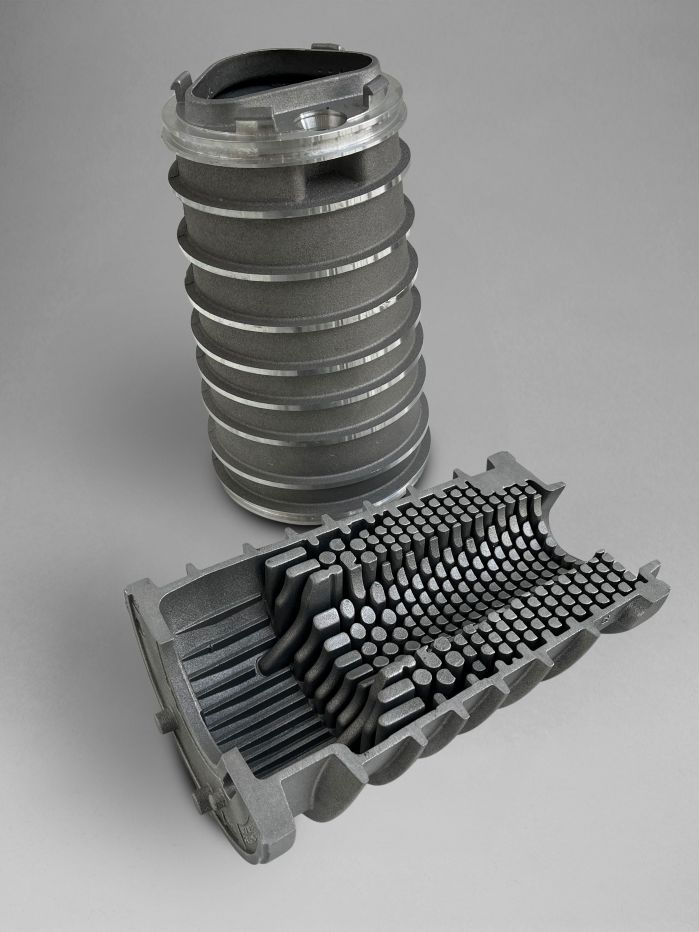
Eren: With DISA green sand moulding you can do complex cored castings and reach surface roughness levels as smooth as LPDC. Low Ra level enables to get better visual aspects, better mechanical performance (reduces crack initiation) and better sealing. People believe sand casting is between 10-30 µm but we have proved that DISA sand casting surface roughness can go down to 6-7 micrometer.
If you had to distil the value proposition of this partnership into just a few keywords, which ones best define the advantages of choosing the DISA green sand moulding technology for foundries and casting buyers – what would it be?
Eren: I think I will say “Efficiency”.
Edouard: You're right. From my point, its “Cost”.
…finally, equally important…I would say sustainability.
Eren: Sustainability, absolutely.